

Effective erosion control is essential for stabilizing disturbed land, protecting soil, and ensuring vegetation establishment. One of the most widely used strategies is erosion control matting (often referred to as erosion control blankets and turf reinforcement mats). But not all matting is made the same. In this article, we’ll compare natural and synthetic erosion control mats, explore the pros and cons of each, and highlight how to choose the right product for your project.
What Is Erosion Control Matting?
Erosion control matting is a critical tool in slope stabilization, designed to protect exposed soils from the erosive forces of rainfall, runoff, and wind while simultaneously fostering vegetation establishment. Within MKB’s ErosionTech portfolio, solutions fall into two primary categories: Rolled Erosion Control Products (RECPs), which provide temporary to extended protection during vegetation growth, and Turf Reinforcement Mats (TRMs), engineered for long-term or permanent stabilization in high-stress environments. These products can be specified by fill type (straw, coir, excelsior, or poly fiber), netting configuration, and functional longevity, giving engineers, contractors, and regulators flexibility to tailor systems to project-specific requirements. The decision to deploy a natural or synthetic matting solution should be guided by site conditions, expected hydraulic stress, regulatory compliance, budget considerations, and long-term vegetation goals, ensuring performance is aligned with both environmental objectives and project economics.
Register for a Virtual Lunch & Learn Session
Deepen your understanding of inlet protection and explore the latest trends and innovations in the field. During this session industry experts will share valuable insights, practical tips, and real-world case studies.
Earn 1 PDH Credit.
Natural (Biodegradable) Matting
What qualifies as “natural”?
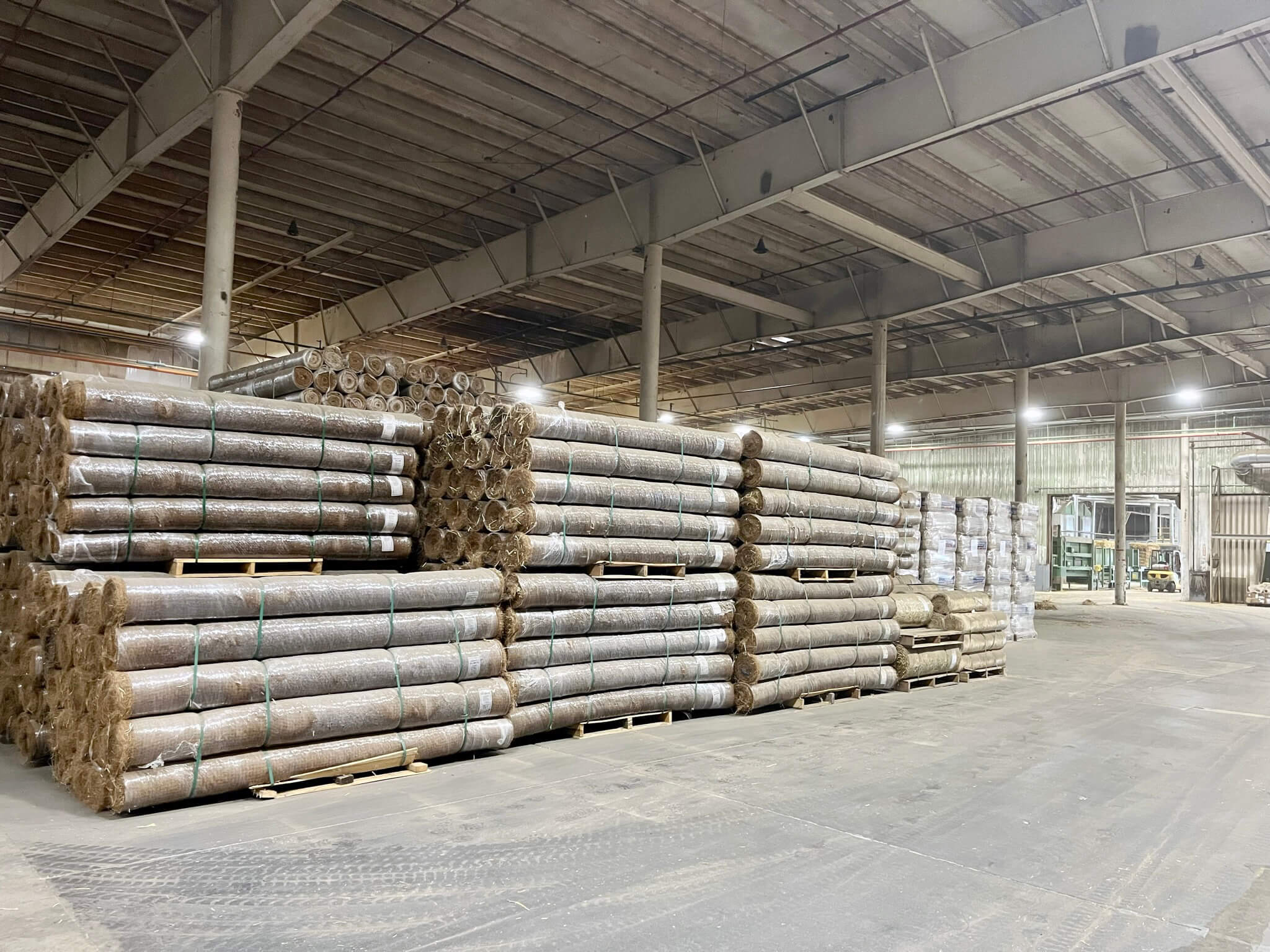
Natural matting uses organic materials such as straw, coir (coconut fiber), or excelsior (wood fiber). The netting may also be biodegradable or photodegradable. Over time, these materials break down as vegetation takes over.
Examples from ErosionTech
- Straw Blankets (e.g. ETRS-1, ETRS-2, variants): Made of 100% straw with photodegradable or biodegradable netting; life spans from ~45 days (rapid degradable) up to 9–12 months.
- Coconut / Coir Blankets (e.g. ETC-100, ETSC-7030): 100% coconut or mix of straw/coir, with longer durability (some up to 36 months in favorable conditions)
- Excelsior Blankets (e.g. ETX-1, ETX-2): Made from wood fibers, with biodegradable or photodegradable nets and a lifespan of up to 12 months.
Pros of Natural Matting
- Environmentally Friendly – Because they break down, they leave no permanent synthetic footprint.
- Supports Vegetation Growth – Organic fibers provide moisture retention and a more hospitable microenvironment for seedlings.
- Lower Upfront Cost – Generally less expensive than heavy-duty synthetic systems.
- Suitable for Short- to Mid-Term Projects – Great for construction overlays, slope protection during planting, or temporary stabilization.
Limitations / Challenges
- Limited durability – Once the material breaks down, if the vegetation isn’t well-established, erosion risks return.
- Less structural strength – Natural mats don’t resist high shear forces or heavy flow as well as synthetic TRMs.
- Variable decomposition – Breakdown depends heavily on climate, moisture, microbial activity, and exposure.
- Installation sensitivity – Must be well-installed, overlapped correctly, and staked properly, or failure risk rises.
Synthetic (Permanent / Structural) Matting
What qualifies as “synthetic”?
Synthetic matting refers to materials like polypropylene fibers, UV-stabilized nets, or engineered mesh. These mats often remain in the ground permanently or have long design lives, reinforcing turf under stress.
Examples from ErosionTech
Permanent Turf Reinforcement Mats (TRMs) – For instance:
- ETPP-8 / ETPP-10 / ETPP-12 – Polypropylene fiber matrices between two nets , available in different weights (8, 10, 12 oz/sq yd).
- ETTT-C / ETTT-PP – Coir or polypropylene fills stitched into triple-net systems.
These mats provide long-term reinforcement well beyond the life of natural mats.
Pros of Synthetic Matting
- Durability & Structural Integrity – Withstands higher flow velocities, shear stress, and longer-term erosion challenges.
- Permanent or Long-Life – Designed to last many years, giving vegetation time to mature fully.
- Stable under extreme conditions – Ideal for channels, steep slopes, embankments, or where soil movement or flood events are expected.
- Consistent performance – Less dependent on environmental decay; behavior is more predictable.
Limitations / Trade-Offs
- Higher cost – Both in materials and installation.
- Less sustainable – Due to its permanent nature, natural and biodegradable materials cannot be utilized.
- Vegetation compatibility – Some heavy synthetic mats make it harder for roots to penetrate unless properly designed.
- Aesthetics and regulatory concerns – Some sites or agencies prefer biodegradable solutions.
Choosing the Right Type (Natural vs. Synthetic): Key Considerations
When selecting erosion control matting, evaluate based on:
- Project Duration & Maintenance: If the site will only need protection for a short term (e.g. during construction), a biodegradable mat may suffice. For long-term stabilization or high-stress environments, synthetic or reinforced mats are often better.
- Site Conditions & Risk Levels: Steep slopes, channels, high runoff, or soil with weak cohesion may demand the strength of synthetic TRMs, whereas gentle slopes or lower-risk areas may be well served by natural mats.
- Vegetation Growth Expectations: Natural mats aid initial growth but rely on vegetation to take over. Synthetic mats must allow sufficient root penetration while providing structural support.
- Budget Constraints: Natural mats often cost less, but you may risk needing repairs or replacement if vegetation fails. Synthetic mats have higher upfront cost but may reduce long-term maintenance.
- Regulatory Standards & Environmental Goals: Some projects or agencies require biodegradable materials or a certain biodegradability threshold, while others permit or prefer permanent systems if erosion risk is significant.
Conclusion & Recommendations
Selecting the right erosion control matting is rarely a one-size-fits-all decision. Natural, biodegradable mats are well-suited for short- to medium-term applications where environmental sensitivity, regulatory acceptance, and cost efficiency are key priorities, such as slope stabilization during construction or vegetation establishment on low-stress sites. In contrast, synthetic, reinforced mats deliver the strength and durability needed for long-term protection in high-flow channels, steep embankments, or areas where vegetation alone cannot provide sufficient soil stabilization. In practice, many projects benefit from a blended approach—using natural mats to encourage growth across broader areas, while strategically reinforcing vulnerable zones with synthetic TRMs for lasting structural integrity. By aligning material selection with site conditions, hydraulic forces, and long-term performance goals, engineers and contractors can maximize both ecological and economic outcomes.
To discuss which erosion control solution best fits your project, or to explore MKB’s full line of ErosionTech products, contact our team today.