

MKB Anchor Reinforced Vegetated Systems (ARVS) Permanent Erosion Control Systems combining Turf Reinforcement Mats with Percussion Driven Anchors
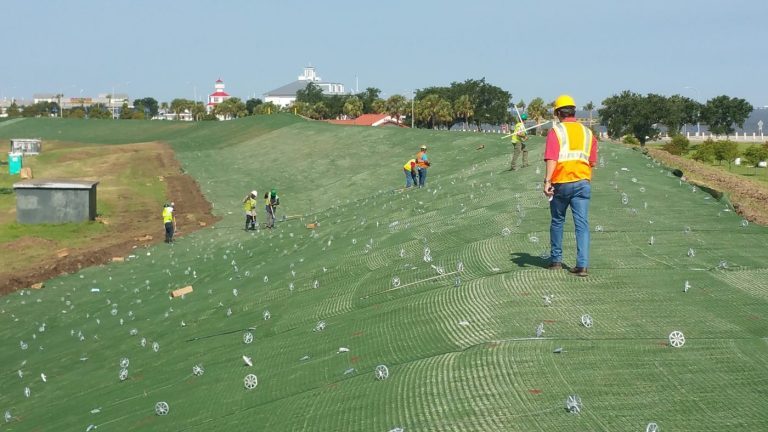
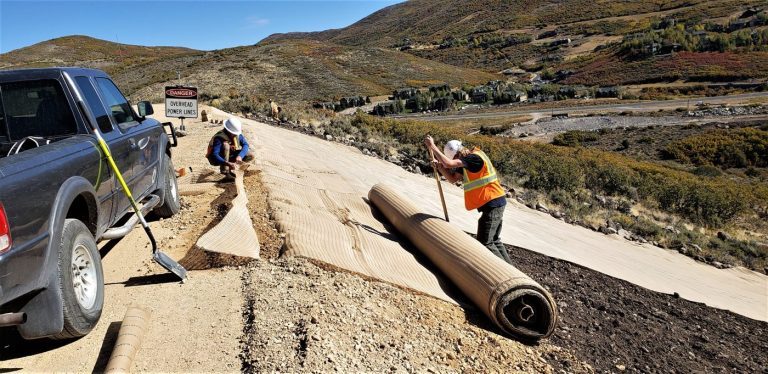
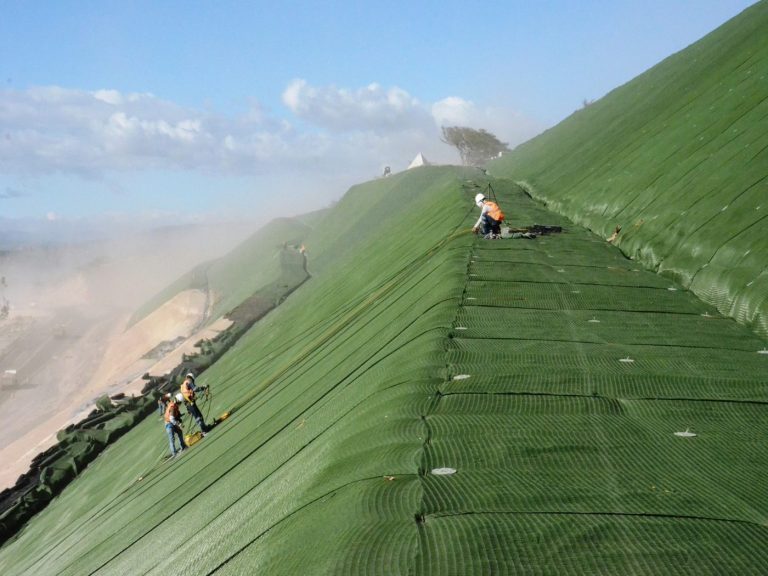
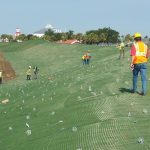
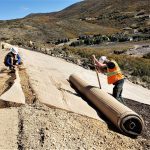
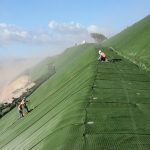
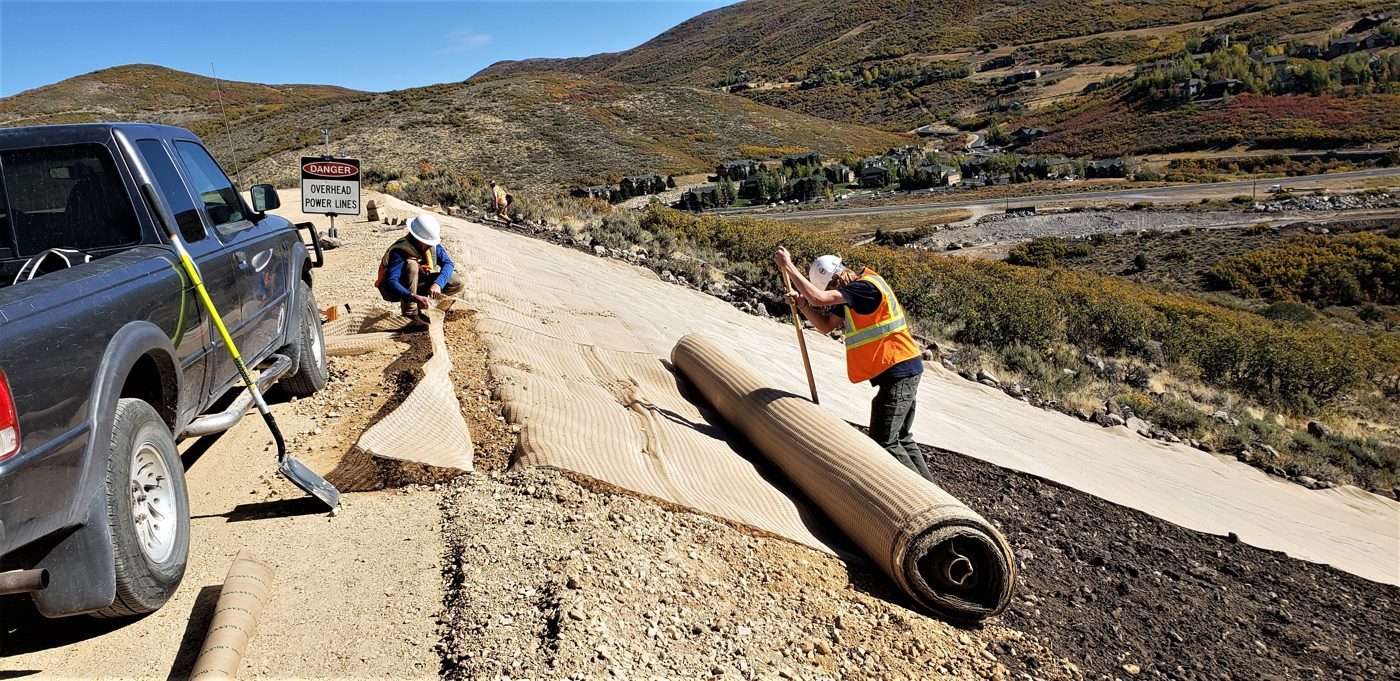
Anchor Reinforced Vegetated System (ARVS), combine woven Turf Reinforcement Mats (TRMs) with Percussion Driven Anchors™ (PDA™s) to create an armoring system that is mechanically secured to the ground surface. The durability of the woven TRM provides confidence to install in high loading/high survivability applications.
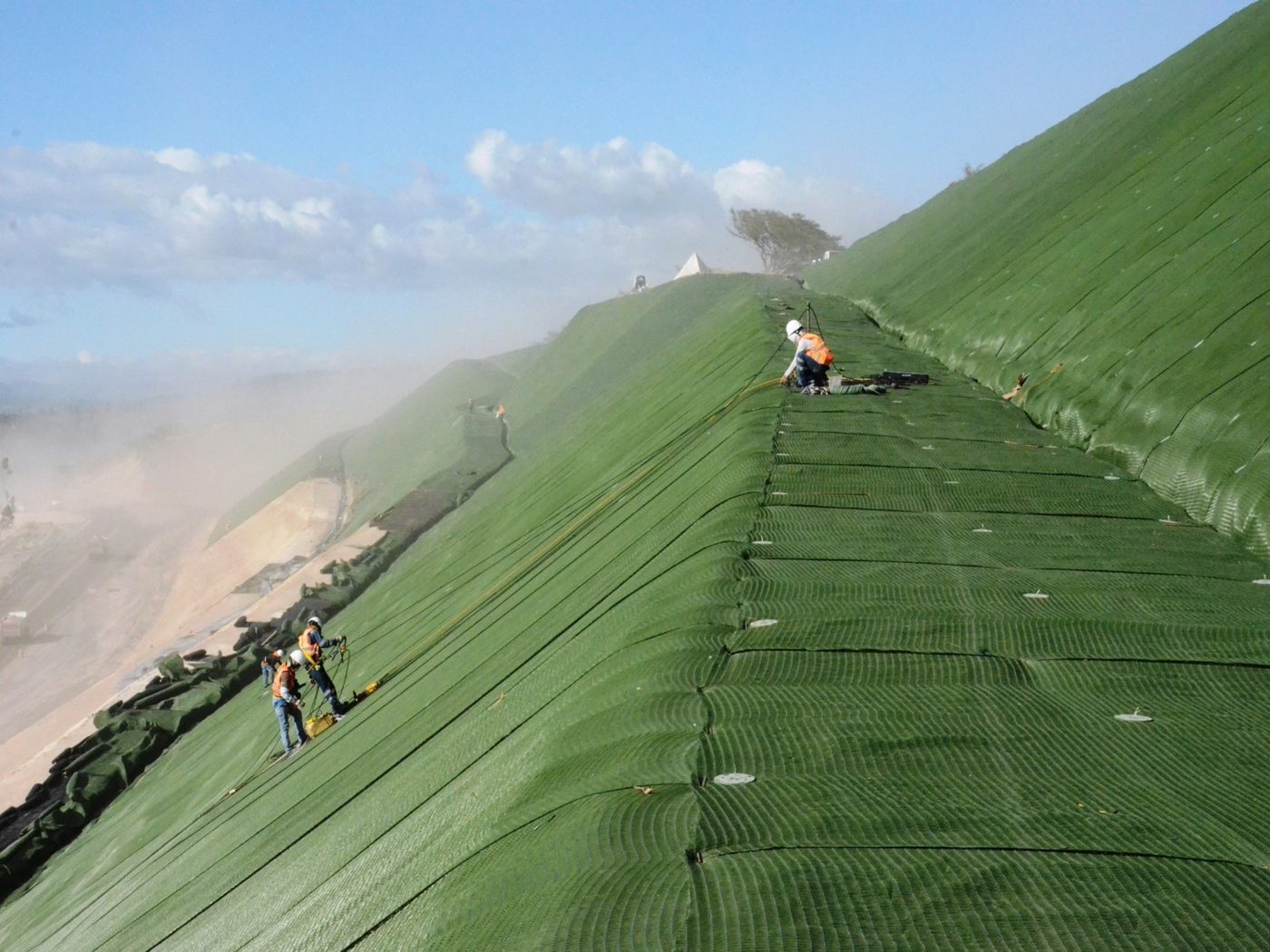
MKB ARVS harness the strength of the fabric to hold saturated, surficial soils while the anchors develop deep penetration into the ground surface to reduce or eliminate the possibility of shallow plane failure. The utility of the combined system provides a high performance, reliable cost-effective means to replace rock riprap in many applications. MKB ARVS is available in a suite of standard configurations to address a range of project challenges or custom configurations that can be designed to optimize performance and value to site-specific challenges.
Why Choose MKB Anchor Reinforced Vegetated Systems (ARVS)?
Maximum Shear Thresholds
Engineered to perform in extreme hydraulic and wind-driven conditions.
Unified Protection
Integration with anchoring systems ensures the ARVS remains securely fastened to the subgrade.
Deep-Root Anchorage
Encourages deep-root development, creating a long-term, stable vegetative armor.
Reliability
Proven performance in critical hydraulic applications, such as spillways and high-velocity channels.
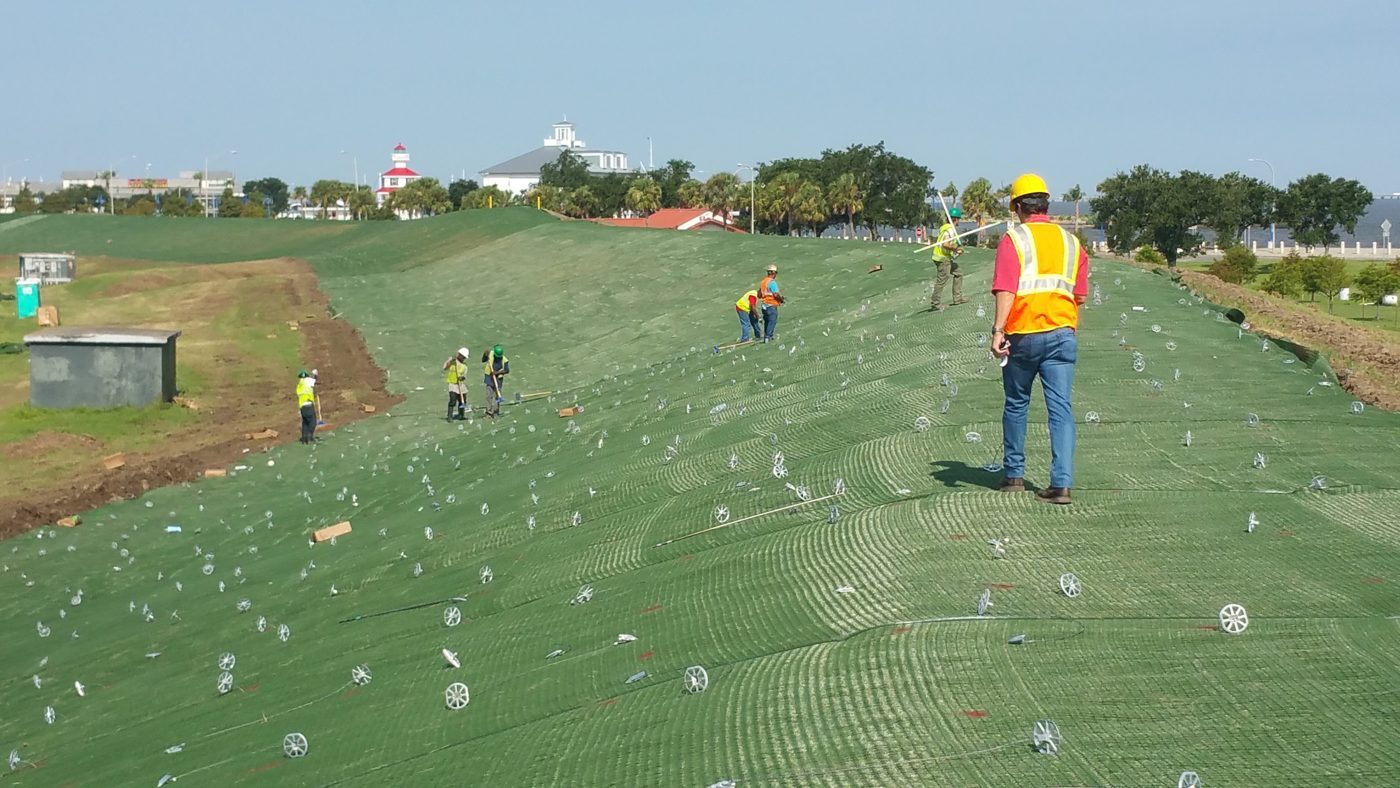
Typical applications
- Channel and Ditch linings
- Steep slope stabilization
- Levee and Dam reinforcement
- Shoreline and Riverbanks
- Landfill and Mine Closures
Product details
Anchor Reinforced Vegetated System (ARVS) Selection
Step 1. Select High Performance Turf Reinforcement Mats
To build an ARVS system, first select the HPTRM matting. We have a range of high-performance options that can meet your performance and strength thresholds. From our entry level HPTRMs PP5-Pro and TMax-3K with shear stress performance up to 14 lbs/sf and tensile strength over 3,000 lbs/ft.
For the most extreme applications our optimized HPTRMs, PP5-Xtreme and TMax, can showcase performance up to 17 lbs/sf and tensile strength up to 4,000 lbs/ft.
Step 2. Select Anchor
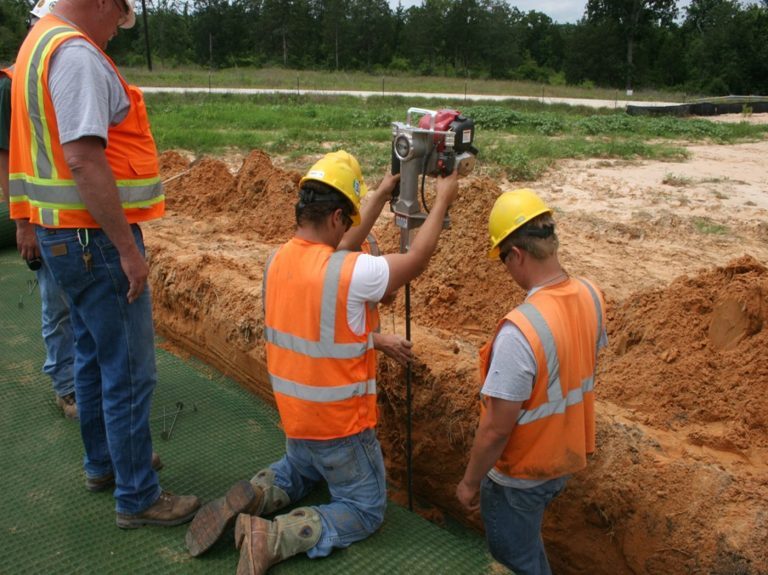
To finish building the ARVS system, the anchoring solution must be selected based on soil and site conditions. The Falcon Hex Pins are suitable for moderate loading and survivability, while our Falcon Anchors should be engineered into the ARVS system based on additional application needs — the F80 anchor for surficial slope and high loading capabilities under hydraulic stresses, F120 anchors to handle extreme loading at greater subsurface depths, and the F170 anchors for ultimate loading and strength for structural support.
Engineer an MKB Anchor Reinforced Vegetated System with:
Frequently asked questions
A: An ARVS is an engineered erosion control solution that combines a high-performance turf reinforcement mat (HPTRM) with mechanical earth anchors. By physically pinning the system deep into the subgrade, the ARVS creates a unified, reinforced soil mass. This delivers the durability and shear-resistance of traditional “hard armor” (like concrete or rock riprap) while promoting a natural, vegetated landscape.
ARVS should be your primary choice for high-risk, critical infrastructure where the consequences of slope or channel failure are significant. Ideal applications include dam embankments, spillways, steep levees, and high-velocity drainage channels where hydraulic shear forces exceed the capacity of surface-applied mats.
Standard mats rely primarily on their own tensile strength to resist erosion. In contrast, the mechanical anchors in an ARVS penetrate deep into the soil strata, anchoring the system to the subgrade. This prevents the “lifting” or “tunneling” that can occur during extreme hydraulic events and ensures the mat remains in intimate contact with the soil, which is essential for healthy, long-term root development.
ARVS offers a “green” alternative that matches or exceeds the shear stress thresholds of rigid materials. Unlike concrete, which can crack due to settling, or riprap, which can be displaced over time, an ARVS is flexible—meaning it conforms to the ground surface even if the soil shifts.
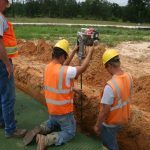
Yes, the installation requires higher precision than standard erosion control blankets. It involves the layout and mechanical installation of ground anchors at a specific pattern and depth, through the reinforcement mat. Because this is a structural system, it is vital to follow site-specific design specifications regarding anchor density and placement.
Copyright © 2026 MKB Company LLC. | All Rights Reserved
All statements, product characteristics, and performance data contained herein are believed to be reliable based on observation and testing, but no representations, guarantees, or warranties of any kind are made as to accuracy, suitability for particular applications, or the results to be obtained. Nothing contained herein is to be considered to be permission or a recommendation to use any proprietary process or technology without permission of the owner. No warranty of any kind, expressed or implied, is made or intended. EnviroSoxx®, Filtrexx®, Filtrexx SiltSoxx®, GreenLoxx®, GroSoxx®, Powered by Filtrexx®, Siltron®, Storm Catcher®, StormExx®, Straw Max®, Switch Sock®, the branch & leaf logo®, and the color GREEN® are Registered Trademarks of MKB Company. DiversionSoxx™, FilterMedia™, GrowingMedia™, and SwitchSoxx™, are Trademarks of MKB Company. US Patents 7,226,240; 7,452,165; 8,439,607; 8,740,503; 10,167,620; 10,704,247; 11,098,472; 11,466,413 and Patents Pending 63/221,435; 62/964,021; 18/114,601; 62/349,890; 17/459,534; 63/070,891 may apply.